

How Blind and Low-Vision People Are Reclaiming Style and Fashion with Anna Cofone

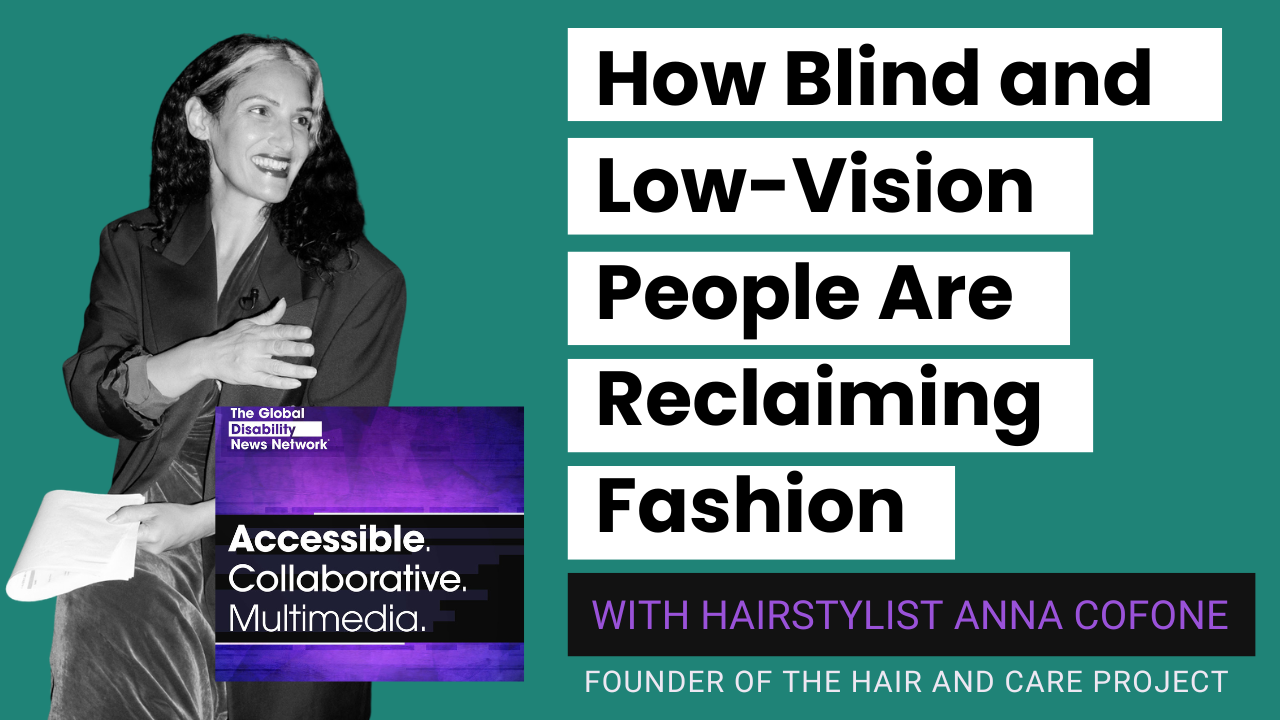
Fashion is one of the most visual industries in the world, so where does that leave blind and low-vision people?
In this episode, hosts Karina Sturm and Amy Zayed talk with Anna Cofone, founder of the Hair & Care Project, about how hair, beauty, and style become powerful tools of identity, confidence, and belonging. Anna shares how her father’s sight loss inspired her work, what really happens inside her accessible hair workshops, and how she’s brought touch tours, audio-described runways, and even a blind model with her guide dog to London and Copenhagen Fashion Week. This conversation explores disability, self-expression, and who gets to feel seen. Watch, share, and let us know your thoughts in the comments.
0:00 – Welcome to the Global Disability News Network
1:23 – Where Hair & Care began: Anna’s father
4:03 – Style as identity and quiet coping
5:53 – Inside a Hair & Care workshop
8:15 – The ripple effect: community and confidence
9:52 – Amy’s story: family, tailors, and Vivienne Westwood
15:14 – The 2019 moment that launched Hair & Care
18:52 – Training stylists to work with blind clients
23:11 – Styling a blind client: touch and description
25:44 – Making Fashion Accessible: touch tours and audio
31:44 – Lucy Edwards and Miss Molly walk the runway
37:02 – The industry’s fear and the Purple Pound
43:23 – Heightened senses, personal style, and the 2029 vision
Watch the Episode here:
Listen to it on your favorite podcast player:
Karina Sturm: Welcome to the Global Disability News Network podcast, powered by GADIM, the Global Alliance for Disability in Media and Entertainment. We are a disabled-led, accessible multimedia platform where disability isn’t a side note. It’s the lens we report on how systems, culture, and everyday life affect disabled people around the world while centering lived experience and disabled perspectives. I’m Karina Sturm, the news director of the Global Disability News Network, and your co-host with me is co-host and fellow journalist Amy Zayed.
Amy Zayed: Hello.
Karina Sturm: And today we’re talking about fashion, about disability access and what it means to be seen in the world of fashion where disabilities often forgotten or ignored. We are talking about how identity and self-expression through fashion can empower you and about breaking barriers and changing stereotypes around beauty. We’re joined by Anna Cofone, the founder of the Hair and Care project, which helps empower blind and low vision people to find their style, play with it, and gain access to the fashion world. Welcome, Anna.
Anna Cofone: Thank you. Hi. It’s lovely to be joining you both. Thank you for inviting me onto the podcast.
Amy Zayed: It’s very lovely to talk to you now. Where did the idea come from to all of a sudden work on accessibility and blindness and fashion and stuff?
Anna Cofone: Yeah. Basically my, it’s, it came from lived experience. So my father had retinitis pigmentosa. He was diagnosed in his mid twenties, an Italian immigrant who moved to the UK when he was 18. And so as a child and being one of, three siblings, he, we experienced just how that confidence and identity changed for him as he was losing his eyesight. And, but, the thing that for me, always just stood out about that, time as he was progressively losing his sight, was just how important his appearance remained for, him. He really valued dressing well, wearing aftershave, always being clean shaven. And I think looking back that helped him retain his identity and, sense of confidence and autonomy. He. He wasn’t recognized. Oh, Giuseppe the blind person. It was, hi Giuseppe, you look great today, or, you seem wonderful. And I think fast forward to 10 years after he passed away. So we lost him in 2009. I found myself at a point in my career whereby I, want, I really wanted to give back. I’d been so fortunate, as you mentioned, working with some of the most incredible artists in the industry. And, styling, designing hair for runway shows as well as working on multiple magazine covers, fashion shoots, advertising campaigns. And I think, I was just really needing to give back and to, Honor his memory and, the, power of, self care and identity. And so the idea of Hair and Care was really born from, that and from this understanding that through our hair, our appearance, our makeup, we have the power and blind and low vision people have the power to help themselves feel seen and help create a better sense of self and of, and identity.
Karina Sturm: Can I ask a question about your dad? Do you think did he use style and being stylish, as a form of identity? So he wouldn’t be like disabled first, but he would be like the cool guy first.
Anna Cofone: Oh, absolutely. Absolutely.
Karina Sturm: So it was a little bit of coping maybe for him as well.
Anna Cofone: Absolutely, I think, we didn’t. We never really questioned it growing up, it was just so natural and, such a, important part of his routine. Even as the, his eyesight became severely impaired, he would still wear a beautiful suit. He would still always wear, after shave. And I see now I, and having, worked with Hair and Care and, developed these workshops and making fashion accessible for more than five years, six years now, I’m, seeing just how that is resonating with blind and low vision women and young girls. It, there is this idea that, it’s not an idea. There is this ability of it being not only a coping mechanism, but a way to feel, seen, a way to boost confidence and, improve so many other aspects of a blind or low vision person’s life.
Amy Zayed: I think it’s always a participation in, in regular normal life I felt in my life where access was denied just through it not being there. And what you do creates access. Which is Great. But let’s like go into the logistic. Stuff. If Someone has no idea what Hair and Care is all about, what happens in Hair and Care.
Anna Cofone: Hair and Care are monthly workshops that we deliver free of charge at our studio in Hackney, east London. We. Essentially, each workshop that runs for two and a half hours are about teaching blind and low vision people how to care for and style their hair. We, there’s always a, an introduction and yeah, a first step where a person gets to learn about their hair type. We help them with, understanding the, what language to use when describing their hair so that. Away from the workshops, they’re also feeling empowered to go into a salon for a, haircut, for example. So we, take them through that, language. We help them understand what their hair type is, what might suit them. And then we also go through, various tools and accessories from how to use hot tools safely to. What is what are the best tools for their hair, whether that’s a pick comb, a detangling brush, a brush that has ceramic bristles versus, natural boar bristles, for example. And so it’s this all encompassing, inclusive, and accessible workshop. And every workshop is different. So we’ll go from after that introduction session, there might be a session that’s all about, creating volume. And how can that be done in an easy, accessible way at home? As, as well, as Them being able to ask for it in a salon or learning how to do it with our support in the workshop. We also have some really creative sessions. So we’ll be teaching them how to make, flower crowns and other beautiful hair
Amy Zayed: Ooh, I wanna come.
Karina Sturm: Yeah, me too. I’ve it doesn’t sound like it’s necessarily a workshop for blind people. It sounds like it’s a workshop for people who have no clue about how to style themselves, but you would also include myself,
Anna Cofone: Yeah. You’d be absolutely, welcome. I think what, one of the wonderful things that, we see with these workshops is the sense of community. We underestimate, I think as a, society, just how valuable and important self-care, but then experiencing that with, other people, and obviously, the, sessions are for only blind and low vision people. So again, there what, we are encouraging is people to feel, a part of something. And We’ve had participants who have come to our workshops with no confidence, with no self-esteem. Very, shy. Maybe they’re at the beginning of their sight loss journey. And, four years on, we have, a, actually a participant who is now the life and soul of our workshops. She’s, she, will share, hairstyles that she’s been able to do at home. She’s very welcoming of, new participants and that’s the ripple effect, that the ripple effect of self-care of these workshops. They, help to. Better connection, human connection, and, as a result of that, it’s affecting positive mental health. It’s reducing isolation and it’s creating friendships. So there’s, so much that then happens as part of this wonderful, empowering ripple effect.
Karina Sturm: Amy, I know you are into fashion much more than I am.
Amy Zayed: I dunno. I love fashion. Yes.
Karina Sturm: How did that start for you
Amy Zayed: For me. Oh. I was born into a family with a mother? That’s completely obsessed with fashion and my grandmother was. Two, like I remember when I was three, four when I was in Cairo. ’cause My, mom and my dad both come from diplomat backgrounds. So we had, a family tailor and I remember my grandmother taking my mom and myself, to our family tailor and, looking at how, maybe she found something by Versace that she would want. To create. And then the tailor would fit things. And I would be there and touching all the, textures and all the fabric and loving it. And obviously seeing my mom dress up. You do the things that every girl does, no matter whether you’re blind or not You, try on your mom’s makeup. And completely mess up your face and you try the higher heels on and then stumble and fall. And then obviously when I was like 13, 14, I was at a regular school. So not a blind school, regular school. And then we started going shopping as girls, and I Started wanting to create my own style. And my mom was very welcoming. To That She was like, yeah, Go ahead. Do, what you feel, whatever you like. But when you go out with your friends the, even your friends or their moms, would go ah. Haven’t you got someone to do, that for you? You’re blind after all, stiff upper lip, how, dare to have your own style. This is not good. How can your mother let you do. This? And obviously that makes a 13-year-old fairly unsecure. ’cause you all of a sudden you think oh my God, am I doing something wrong? Obviously I wouldn’t show that because I was too cool for school and would like just, pretend it wouldn’t absolutely not affect me. And I would like, I do what I want.
Amy Zayed: I’d go to my mom and say, is it okay? And she’d of course it, is. You need to. Know it’s your identity that you’re showing with your clothes. And obviously I would say, oh, it’s my mom. So I’m, she has to say this until, I was in London when I was about, 15. And I, by coincidence, stumbled over this article. It was an interview with Dame Vivienne Westwood,
Anna Cofone: Hmm.
Amy Zayed: Who went on about. Style being identity and you being allowed to fail. And that style isn’t like something that you develop and then it’s there, but it’s a progressive thing that always develops and you fail and you get up. And maybe in 10 years time you say, oh my God, what was this all about? Why did I do this? And it’s nothing to do with whether you’re blind or whether you are curvy or whether you are, whatever your race or gender is or whatever. It’s to do with your identity that you want to express, and you have the right to do that. And I read it, and it was actually exactly the same that my mom said, but because it was Dame Vivienne saying it was like. Wow, this is it. And that was my wake up call. And I think to this day, I have massive respect for this lady. I, she got away from my microphone, I’m afraid, but one day I would’ve loved to interview her. So now all I have is doing a legacy, doing her legacy, good. And doing hopefully one day a big documentary about her.
Anna Cofone: That must have been so powerful for you, Amy, at that, age. I can, just, I imagine what the, that, what that must have, done for your confidence because there was that permission right from someone, as such a prolific designer. That’s just so powerful.
Amy Zayed: Absolutely. And when I got into her and thought, she, even in the nineties when it wasn’t, I mean she wasn’t a pioneer, but she was one of the few people back in the nineties that would, get black women on the, catwalk. And I was like, I don’t see anyone blind on the runways. At least I’m seeing someone of color. Because, I didn’t feel represented in this industry at all.
Karina Sturm: I always felt particularly when I got chronically ill, I felt like it’s so time consuming and also. Taking so much energy to look good and to look cool. So what I would love is like a workshop, not that I’m saying that you shouldn’t do the workshop for blind people, that is incredibly important. But if you do more in the future, I would love a workshop that teaches you like how to look good with like very simple things and that don’t take much energy, simple haircuts that can be styled easily. Stuff like that. That would be so helpful to people like me. I think.
Anna Cofone: Yeah. Yeah. We’ll, there’s lots of, there’s of exciting things happening on the horizon, Oh, yeah. A absolutely. I can remember the, moment for me it was, 2019. It was, 10 years to the day that my father had passed away. And I was on a walk with my wonderful dog who, Chiefy who healed my heart, after my dad passed away. And we were on a walk in, through Hackney and we walked past, we were in Dalston and we walked past the Royal Society for Blind Children. Their head office at the time was there. And so it, I’m, I think as a result of growing up, with a blind parent, I had this very fortunate, and privileged opportunity to develop quite a strong sense of, intuition and, in, believing that moments happen and act as these, powerful seeds of ideas and of, change. And so I, think I went home and I just knew that was the right moment. I think for me it was, feeling, the grief, the sadness of, my father not no longer being with us. And it being the 10 year anniversary, I literally that afternoon called the Royal Society for Blind Children. And I said, hi. I’m Anna, I’m a hairstylist. I live in Hackney. I am thinking about this idea. I’d love to know from your point of view, is this something that blind and low vision children, young adults would benefit from? And the answer was yes. And then that followed through with a meeting at the office where I delivered the idea. And it w it was all very much led from the heart and from that lived experience of just seeing how, self care was at the root of, my father’s ability to retain his confidence and his self-esteem. I thought, if I can bring this to the table and if I can help educate young people on the power of this through very, simple tools and skills in time, they will. See, we will see as a community the benefit that this will then have on them, because it’s very subliminal, it with some that change can happen almost instantly with others, it can take months or even years. But RSBC, were jumped straight on board. Obviously then we were hit with COVID. And so the, session started online with, one of their wonderful programs called the Sisterhood. So it was a, these were, it was a community created, specifically a space created specifically for the young, women and girls that were part of the, RSBC service users network. Because they had identified that during COVID there wasn’t a safe space for girls to just come together and talk about the needs and the frustrations and the difficulties that they were facing as blind and low vision girls in COVID. And so the, so Hair and Care was born through in COVID through the sisterhood, online sessions.
Amy Zayed: Talking about online sessions, now COVID is over and you’re doing this, not well in presence rather than remote. How do you train your hairstylists that do, that, do these workshops? Because I think a lot of hairstylists sometimes have never, ever seen a blind person. Sometimes I walk through a door in, a, in a hair, in a, to a hairdresser shop, and they look at me as if I’m, I don’t know, an alien that’s just walked through the door. And, how do you train. The stylists to come and not be completely insecure, uncertain what to do because it’s a very haptic pro process. You need to show people how to, how to touch their hair, where to touch it. So it’s a very kind of, yeah, you have to be really close to each other to do it. And it.
Anna Cofone: Absolutely. We, so all of the hairstylists that volunteer at the workshops, and we tend to have a, one-to-one ratio. So it will be one hairstylist per blind or low vision person. And so anyone, who, any hairstylists who register to volunteer with us, they are, they’re taken through a training program. That’s something that they, we send them online that they have to read through. And then on the day that they come to volunteer, we meet with them a couple of hours before and I take them through, Some role plays. So I actually get them to close their eyes, and I take them through certain, accessible and inclusive language, and then I get them to mirror the same back to me and I, close my eyes so that they can, so that they can really experience what it would feel like if they used language. Like the chair is over here. And so we have this, a very intimate role playing training session. Which it really helps to set them up for what they then go into initially they’re shadowing, so they’re observing other hairstylists and how I am teaching during the workshop. And when we see, the participation and when we can understand that they’re using the right language and that it’s accessible and it’s inclusive, then we start pairing them. With a blind or low vision, woman or young girl. So it’s, it’s this wonderful, ecosystem. We, are, they’re not just volunteers, we are upskilling them and they’re able to then take those skills back into the salon. Many of them do work full-time in a salon. And again, this magnificent ripple effect is happening within the hair industry as well, because we are hearing directly from them that they’ve been able, they’ve got the confidence to share on social media or on their salon’s website that, they are able to welcome blind and low vision people to the salon because they have been trained by Hair and Care. And actually we, recently had one of our volunteers do their first haircut for a blind, woman, who went to visit her at the salon. And she said that, many of the other stylists in the salon that have not been a part of our workshops. Commented on how, I think her, when hairstylists hear certain language for the first time, it’s only at that point that they realize the power of it and the need for it. Because again, it’s very easy to say, oh yeah, of course I’d be able to welcome a blind or low vision person. It’s easy. I just take their hand. But as we know, it’s not just, about that. Yeah, it’s, and again, this is this is the bigger vision for Hair and Care that, we’re not just helping blind and low vision people. We are also helping to make a change within the hair, beauty, and fashion industry.
Karina Sturm: You said that, you teach them like how to do a blind person’s hair, for instance, but like, how can I imagine, what do you teach them what they have to do when a blind person comes in and is Hey, I wanna have this and that haircut.
Anna Cofone: I think it’s all about, being tactile, and I think having, creating that safety, I’ve al always with our participants and with our volunteers, we’ve, we’ve shared with them that saying, for those, especially for those who have, been born blind, understanding where a middle parting is a side parting or say, beautiful waves that frame the face, that’s descriptive language. But then actually. Helping hand to hand guidance so that a person can then actually feel what that feels like. Only then can a blind or low vision person understand the movement and the wave and the curves to a Hollywood wave, for example, framing the face. And so it’s really about, having hairstylists and blind low vision people understand that part of that, that safe, that creating that safe space and creating this accessible, language and service is about also having the, that tactility. And also encouraging hairstylists and educating hairstylists to ask this, the question, can you share with me what your level of visual impairment is? And because for every person, and again, what we’ve experienced over these five years is that there are varying nuances. You’ve just described being able to see red and understanding red and orange, and we’ve got a participant who, just has peripheral vision from her left eye. And so again, encouraging that open conversation so that. What, whatever the person, the blind or low vision person, experiences from whatever visual, understanding they do have that can then help develop this very, unique conversation with, the hair, with the hairstylist.
Amy Zayed: You’re doing something else called making fashion accessible. So you take, you’ve taken it a bit further than just doing these workshops. And what, I understand of making fashion well, or rather before I talk about what I understand what it is, would you mind explaining what making fashion accessible actually is?
Anna Cofone: Yes. So it, is about making runway shows accessible for blind and low vision guests. It, started, again, as this idea of, it was more about a feeling that I had working backstage. I’ve been really lucky to work at London, Paris and Copenhagen Fashion Week now for more than eight years. And, I would find myself backstage thinking, we, put in all this work for an industry that’s so visual and talks about diversity. It’s an endless conversation. But actually, where are the descriptions? Where is this missed? Why is there this missed opportunity of, Having touch tours and where are the blind people included in these conversations and where are they at runway shows, why aren’t we, why aren’t we making shows accessible? And why is there this continued perception, that blind or low vision people don’t care about fashion or don’t care about how they look?
Amy Zayed: How did you approach designers then? I guess it was, because you have the lived experience, but I guess some designers looked at it at you as if you were talking about rocket science.
Anna Cofone: The thing is, Amy, coming back to this, the start of our conversation and, being an ideas person, but also someone who doesn’t really, rarely takes no for an answer. It. That was the case. I basically, every show that I was backstage at designing the hair for, I asked, told the designer what I was doing, what we were going to do. Because obviously there was the very first designer, Sinéad O’Dwyer, who, we launched the idea with, back in February 24. And it was just very much a conversation around, I’m doing this, I want to do this. I think this is really powerful. This is gonna help broaden and expand this conversation on accessibility and inclusion. Would you let me bring blind and low vision people to your show? And would you allow us to audio describe each piece as it’s walking down the runway in real time? And then can we organize a meet and greet with. Those guests can also touch the garments and understand what your visual and creative process was curating the collection. And they didn’t have, they, don’t get a chance to say no. Sometimes it’s difficult. Sometimes it’s difficult. But in the end, they come through. They come through because they see the power in it, and they, yeah.
Amy Zayed: How do, who do you, who does do the audio descriptions and who, it’s a logistic thing. I do it for theaters sometimes and it takes ages. So who organizes it and, are blind people involved in it? How does it get paid? Like all this kind of logistics stuff that goes through my mind.
Anna Cofone: We, do everything in-house. So my incredible team, run. All the production and logistical elements to making it happen. So we, work with the designer that, they provide us with the descriptions, the written descriptions of each look, which in most cases they’re not, happens at around midnight the night before the show, because that’s the only point when, the casting and the order that the models will walk in is confirmed. And so we then, audio record, voice record, each description. We liaise with the choreographer to make sure that the spacing, is considered, because we. Believe that it’s important that our blind and low vision guests get, a real experience. So they are hearing the description at that point when that model is walking past them. Sometimes it doesn’t always go to plan because sometimes models will walk a little bit faster, but, yes. So coming back to your question, our blind guests are a part of it. They get to meet the designer a week before their show. We bring them to the designer’s studio. So it’s a very intimate and, exclusive, experience, but one that is wonderfully inclusive. The designer will talk through their inspiration and then they’ll actually allow our guests to feel, the pieces, especially ones that have interesting textures, or, silhouettes or, an appliqué or sequin. And so they, so our guests have this, they get this opportunity to already create a, very vivid image themselves of what this piece and the pieces will, look like and sound like when they’re walking down the runway.
Amy Zayed: How do you know or how you have did, because I know that you, I think in Copenhagen a couple of years ago, you made, a very well known, blind British influencer and, TV journalist, Lucy Edwards, get on the ca well get on the runway and walk a fashion show. I think that was amazing and I think it gave the fashion industry like this nod. Why aren’t there more blind models out there, is this something you pursue? Do you know more blind models? And do you think it could happen at some point?
Anna Cofone: I, absolutely do. I think, you know what we, what I understand, of the industry from the different conversations that we have, and not just with designers, but also hair brands, there is a fear. And, so our duty, our job is to be a part of that conversation and the education, and I think when they see what we do and how we do it and how easy it is, that helps to dissipate the fear. And so for us, that show was all about showcasing. A blind model walking the runway and how actually with the right care and inclusion and preparation, it can be done in the most cohesive way that didn’t then, feel in any way like a senseless act of tokenism, because that we are very mindful when we approach designers. We want it to feel authentic. We want it to be not just about a PR moment, but because the brand believe in it and understand that inclusion should be at the forefront of any decision making and not an afterthought. So it, we spent wonderful Lucy, who I a adore so much, we spent four hours the day before with her guide dog, miss Molly. Walking the runway. It was a really difficult space in that we were in a park with many curved pathways. It was meandering in and out of the audience, so it wasn’t a straight runway, it was a huge, undertaking. And, I just have this wonderful memory of, miss, Molly feeling really tired, not knowing. I, think she’d reached a point where she didn’t want to learn anymore. And so we actually got, bacon treats and we were, there were these, there were these art pieces in the middle of the runway. These like art, it was installation pieces, which acted as another barrier because they, at some points, they were placed literally in the middle of the runway. And so not only did. Lucy and Miss Molly have to learn the, curved pathways. They also had to navigate then walking around those pieces of artwork. And so we actually had to rub bacon around the art piece so that Miss Molly would walk around it and then centralize herself again on the runway. It but that’s where the difference is. It’s, about that preparation. It’s about that open conversation and making sure that no stone is left unturned, excuse the, cliche metaphor. But, it really is about that. And, everything that we do at London Fashion Week and making the shows accessible, with every show there is just another. Load of hurdles that we have to overcome. And that can only, be managed through these through preparation and conversation. And because actually the problem solving is really easy. It’s, really, easy. And our, mission with making fashion accessible is, yet yes, we would love for Brit, the British Fashion Council to commit to making every runway show that’s on schedule to be accessible for blind and disabled, audiences. But I think a greater, mission for us is that we help brands to understand and learn how they can make every aspect of their business. Accessible and inclusive. It has to be how the consumer buys the product, how the blind person buys the product online, how the bright blind person gets to observe, to experience buying the product in a store. We can’t do all of it, but we certainly want to be at the forefront of that conversation.
Amy Zayed: I think you mentioned something that is sticking in my head at the moment which is the word fear, and, I would like to know where the fear comes from, a designer’s Point of. View or even from a shop owner’s point of view. ’cause I know the fear from, the other, angle. Like a lot of my blind friends, I know a lot of my, especially my blind female friends who find shopping for example, or styling themselves, they find it really. It makes them nervous. It feels like it’s something they’re not in control of and they dunno how to deal with. And as you just said, it may, when you said, when you talked about your Hair and Care workshops, it gives them this kind of self-esteem to be able to do it. But if they don’t ever feel welcome, it felt you, it makes you feel it’s not something you like because it’s always something that you don’t have control over. So I understand their fear, but where’s the fear from the other, what, are they afraid of?
Anna Cofone: I think it’s the fear of the unknown, Amy. I think, we are not, brands aren’t getting the right community in front of them. Because if there were these very open conversations and if there was this better understanding that they aren’t being inclusive, I think that would then help inform them. I think the fear comes from, I don’t know what a blind person would need. So then let’s get them in the room. Let’s get all of them, all of us in the room and let’s help you understand. Let, us tell you, and if I think. Reflect on our work at Hair and Care and making the shows accessible. We have always gone back to our community and asked them, how was that experience for you? What else would you want? Is there something we’ve missed? What isn’t happening with the hairstylist volunteer when they’re taking you through a hairstyle? How can we make that better? How would you want that to be different next time? And, that’s what we’ve got to, I, think working back from this fear, it’s, also challenging these perceptions. I, think overall, the hair, beauty, and fashion industry, not all of them, but I think the majority don’t really consider a blind or low vision person in there. Business plan. I think that the perception is that a blind or low vision person doesn’t care about buying clothes, about buying makeup skincare, about using, hair tools, about, products that they can use to style their hair. And that’s where we’ve got to really start. And I think for some they’re a bit more advanced in that they understand that isn’t correct and it couldn’t be further from the truth. And so there is that, as we, as I highlighted this fear of, what do we do? How do we do it? It’s also difficult out there economically. We, know that brands are not selling really, that there, is a huge, decrease in, people buying luxury goods. So it. What is it that, how do we position it differently? Because I think everything is about incentivization and motivation. I think if we can educate and inform, but then also bring it round to, and I’m always cautious of how this is positioned, ultimately brands need to make money, right? We know that, they need to know how they make money. And so I think us also being very vocal about that and letting them know that, the Purple Pound refer, rip, do they know about the Purple pound? Do they know that it’s the collective spending power of disabled people and their households and how substantial that is. It’s, we’re looking at tens of billions of pounds annually in the UK alone, yet. We know that the fashion industry, routinely overlook this market despite, the fact that there are willing and able customers with money to spend and who want to spend it, who are passionate about, fashion, who are passionate about, their, hair, or are learning to become passionate about it because they’re realizing how that is improving their confidence and sense of identity and autonomy. Let’s have that really honest conversation about, how you can make money as well, how brands can make money from, a community of people who have been, disregarded.
Karina Sturm: And do you have a sense of like how accessible and inclusive the fashion week is overall? Like how many shows? Do you have any sort of audio description or like even a simple thing, like a ramp to the stage? Like how can I imagine the London Fashion Week?
Anna Cofone: Obviously London fashion work is huge. I know there are some spaces that are, pride themselves in being, accessible for, especially for those who are, Impaired with their mobility and are in a, wheelchair or use a cane. In terms of audio descriptions, we were the first to do it, the O’Dwyer show in February 24. And thereafter, the nine shows that we’ve made, that we’ve made accessible were the first to have audio descriptions, but also fabric swatches, that the guests could feel as the audio descriptions were, being played. We, were the first to do that.
Amy Zayed: I think, blind people learn if they, and I think Anna, you probably will, be with me on this, I think. Everyone has their different style techniques. Like some use these technical, tools where they get told the color. I, am completely chaotic in my wardrobe. Like my wardrobe is I think if a sighted person would think this person, this woman would be never able to find anything ’cause I’m as a sighted per, the sighted person would think they would never find something. But I, my privilege is that I can see contrast and that obviously textures look, touch differently. But contrasts help. And I think it’s a lot of research. In my case I did a hell of a lot of research of what errors reflect and why and what. What happens if I wear this? How do I get across what do people see when someone like me with this skin color and this texture and this hair wears this? How does it come across? And I really try things out. Sometimes I failed and then, I realized, oh no, I’d never do this again. And then I tried again. So I think you may say, I look cool, but maybe someone else would think, oh my God, Amy, please you, don’t you complete fashion misfit. Don’t. Don’t please let someone choose your clothes. I dunno.
Karina Sturm: Like taste. Everybody has a different taste, so you know what’s cool for you might be really shitty for someone else, but that doesn’t matter.
Amy Zayed: Yeah.
Anna Cofone: Exactly. Exactly. And I, but I think there’s also, this understanding of, the, he, the heightened senses. I, know from. My experience with, my father, he, loved if I, if we went shopping and I spotted something for him, he’d always say, let me feel the collar, let me feel the buttons. There was something about, lines and curves that helped, especially towards the end of his life where he was in complete darkness. It, that he loved curves. He loved the, touch of silk, he loved, tones of blue. He always felt that he looked his, olive complexion, his Italian olivey skin, looked, its, best when he had a blue was wearing a blue suit or a red tie. And that was. Yes. It was different for him because he was born with sight. So he already had a visual understanding of colors and of shape and of, silhouettes. But I think, with many, of our, guests and our, participants, they, as a result of their senses, their other senses being so strong, they’re able to almost, create visual pictures. We have, a, wonderful, participant who’s become a dear friend and, who consults, on, with us and supports us. Jane Manley. I’m sure she won’t mind me saying her full name because she’s just such an incredible person and, she was born deaf blind, but she is. The, one of the most fashionable people I have ever met. And she loves the descriptions. She loves hearing the sound that a fabric makes. She loves feeling it, she’s been able to create this, style, this sense of style that is very unique, to her. And just coming back to, that point earlier about, the purple pound and challenging these, preconceived ideas, that are mistruths Jane is for me, that, the perfect example of that, she. We have a designer called Chet Lo, who is this, American Chinese designer, and he has this very specific, style to his fabrics. They feel like, they’re knitted spikes. And she has bought since attending his, shows and, we’ve made three of his shows accessible. She has bought five of his, pieces. So from this, spiked headband to shoes and it’s all, how she wears them is all based on her feeling and, visual idea that, she has created herself about how to put those pieces together. And that, for me is, so powerful because as you said, Karina, it’s actually not about what anyone else thinks.
Amy Zayed: I wouldn’t let you go, Anna, before finding out all the amazing things that are happening, or hopefully happening in the future.
Karina Sturm: Yep.
Anna Cofone: Yeah. Look, we, So passionate about what we are doing. Our, mission is to reach as many blind and low vision people, not just in the UK, but in the world. We identify and acknowledge that hair, beauty, and fashion has this powerful ability to create identity, bring people together, and help people feel seen and valued and empowered. So our next step, and this isn’t one that will happen immediately, but the plan for the next, I’d say two to four years, is, putting every, all of our learnings into, digital platforms. And that will cover both hair and beauty, but also fashion. We want to launch those digital platforms. The goal is, God, I’ve not said this out loud to anyone else, but I’m gonna do it now because it feels right to, we want to launch all of this in 2029. That will mark, 20 years since the passing of my father, but it will also be his, 80th birthday. And it will come to life through an accessible and inclusive runway show that we are going to do. We are going to do the casting. It’s going include disabled models, both blind, visually impaired, a. Models in wheelchairs as well. Audio descriptions will be played and mixed with the music. They won’t just be through headphones. So that sighted people can also fully experience every aspect and element of it.
Karina Sturm: Definitely keep us posted about this because I’m sure Amy and I will find a reason to come and
Amy Zayed: Absolutely.
Karina Sturm: Produce stories about it.
Amy Zayed: Abso-freaking-lutely.
Anna Cofone: Thank you so much.
Karina Sturm: Thank you for being here.
Amy Zayed: Thank you for being here.
Karina Sturm: Yeah. Thank you for sharing all of this. Yeah, and thank you everyone for listening, and if you enjoy this episode, please share it, leave a comment and join us next time. Bye
Amy Zayed: Bye-bye.
Anna Cofone: Bye.
Karina Sturm: Bye.
Links:
Hair and Care Project (Anna Cofone’s organization)
https://www.hairandcareproject.com
Hair and Care Instagram
https://www.instagram.com/hairandcareproject/?hl=en
Making Fashion Accessible Instagram
https://www.instagram.com/makingfashionaccessible
The Global Disability News Network
https://globaldisabilitynews.org
GADIM — Global Alliance for Disability in Media and Entertainment
https://gadim.org
Lucy Edwards (blind broadcaster/model in the runway story)
https://www.lucyedwards.com
Sinéad O’Dwyer (designer of the Copenhagen show Lucy Edwards walked)
https://sineadodwyer.com
Chet Lo (designer)
https://www.chetlo.com


